Proactive fuels management for old growth conservation in the Lake Tahoe Basin

Proactive fuels management for old growth conservation in the Lake Tahoe Basin

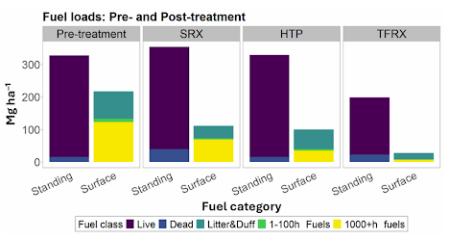
Researchers at the University of California Davis and University of Nevada Reno modeled the outcomes of four fuels management scenarios followed by a simulated wildfire at Emerald Point in the Lake Tahoe Basin (LTB), an iconic MOG stand experiencing these vulnerabilities. The study found that a treatment involving thinning to within the forest’s historical “Natural Range of Variation” (NRV) followed by a fall broadcast burn was most effective in reducing projected large-tree mortality, maintaining stand basal area, and retaining post-wildfire live tree carbon. Researchers also discuss potential management co-benefits of treatments, such as reduced competition-driven tree mortality, increased understory biodiversity, raptor habitat conservation, and reduced air quality impacts.

View Research Brief

View Article (Open Access)

Read More

Reduced fire severity in fuel-treated forests at the Wildland-Urban Interface during the Caldor Fire (2021)

Reduced fire severity in fuel-treated forests at the Wildland-Urban Interface during the Caldor Fire (2021)

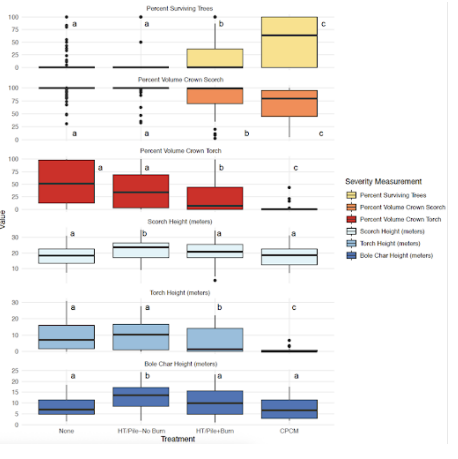
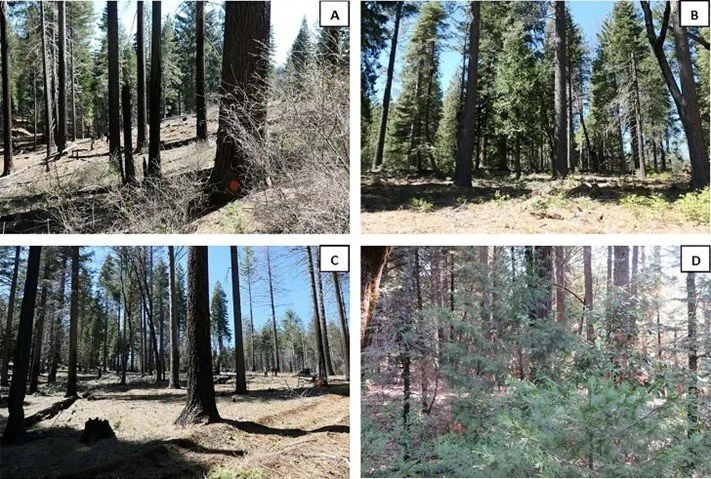
This study assessed tree and stand characteristics and metrics of fire severity in areas within the footprint of the Caldor Fire that had experienced fuel reduction by the Forest Service between the early 2000s and 2019. Treatments were varied, and included hand-thinning and piling (HTP) followed by pile-burning, HTP where the piles were still onsite, and areas where treatment involved two rounds of “cut to length” tree-felling (DBH < 76.2 cm) followed by mastication and surface fuel redistribution to stay below a threshold of 15 cm depth (CPCM). Pre- and post-treatment fuel loadings, stand densities, and basal areas were calculated by combining field data, allometric modeling methods (Forest Vegetation Simulator), and photo series. Each of these metrics was significantly lower in treated stands.

View Research Brief

Read More

Hotter and drier fire seasons increase risk of severe wildfires in western US forests

Hotter and drier fire seasons increase risk of severe wildfires in western US forests

Wildfire activity has been increasing across western US forests, impacting public health, infrastructure, water quality, and the economy. While total annual area burned is often used to track wildfire trends, high-severity fire (fire that kills all or most trees) can have longer lasting impacts on forests and communities and may be a more meaningful measure. Historically, many western US forests experienced frequent, low-severity fires, which promoted resistance to drought, insect outbreaks, and future wildfires. In contrast, high-severity fires in these forest types can lead to forest loss and have negative impacts on post-fire recovery. Understanding trends in high-severity fire is therefore crucial to understanding wildfire impacts on forests and the ecosystem services they provide. Although climate is a key driver of fire behavior, no studies to date have projected how much land could burn at high severity under future climate conditions. This study asks: how is high-severity wildfire changing under a warming climate in the western US, and what might the future look like?

View Research Brief

View Article (Open Access)

Read More

Opportunities to leverage beneficial areas of even undesirable wildfires

Opportunities to leverage beneficial areas of even undesirable wildfires

Successive catastrophic wildfire seasons in western North America have escalated the urgency around reducing fire risk to communities and ecosystems. In historically frequent-fire forests, government agencies are committing significant resources to fuel reduction treatments that can reduce the probability of high severity wildfire. However, even catastrophic fires with large areas of high severity can still have substantial area of lower severity fire that may be improving forest conditions locally, acting as “treatments.” Understanding how these areas of beneficial fire compare and interact with active management can help inform treatment priorities and opportunities. As a test case, we explored trends in the yellow pine and mixed conifer forests (YPMC) in the Sierra Nevada of California over a 22-year period (2001-2022).

View Research Brief

View Article (Open Access)

Read More

Fuel Management Approaches in Desert Wetlands

Fuel Management Approaches in Desert Wetlands

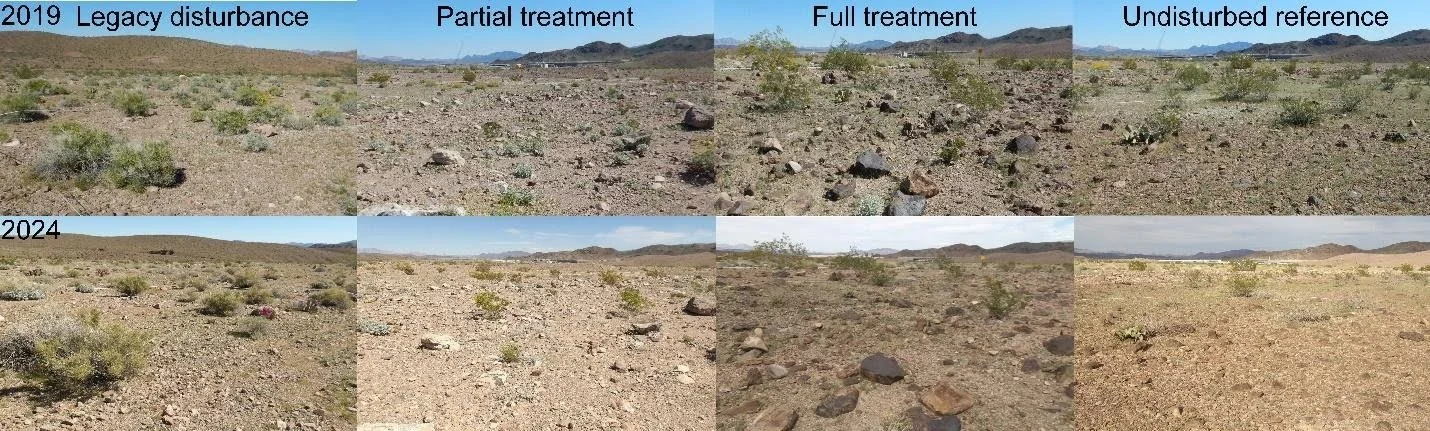
In the Mojave Desert wetlands of Las Vegas, Nevada, a two-year study across 24 sites evaluated the outcomes of different management strategies for hazardous fuel reduction of the invasive common reed (Phragmites australis) and increasing native plant diversity. The study suggests that coupling active revegetation of native species with maintenance management activities to keep reed cover low could be a next research step in identifying long-term strategies for converting reed monocultures to more diverse native, less-fire-prone communities in desert wetlands.

View Research Brief

View Article (Open Access)

Read More

Thinning + burning treatments effectively reduce fire severity

Thinning + burning treatments effectively reduce fire severity

Although fuels treatments are generally shown to be effective at reducing fire severity, there is widespread interest in monitoring that efficacy as the climate continues to warm and the incidence of extreme fire weather increases. This paper compared basal area mortality across adjacent treated and untreated sites in the 2021 Dixie Fire of California’s Sierra Nevada.

View Research Brief

View Full Article (Open Access)

Read More

Where are the Sierra Nevada’s large trees and can they persist?

Where are the Sierra Nevada’s large trees and can they persist?

Identification and conservation of mature and old-growth forests has become a federal government priority.  In California’s Sierra Nevada’s most of the remaining large trees are concentrated on Forest Service and National Park Service lands. We used airborne lidar data to census large (≥30” diameter at breast height (DBH)) and very large (≥40”) trees across three large Sierra landscapes. We found that large trees are either locally absent to rare or are aggregated in stands with 8-20 large trees per acre.

View Research Brief

View Full Article

Read More

The century-long shadow of fire exclusion: Historical data reveal early and lasting effects of fire regime change on contemporary forest composition

The century-long shadow of fire exclusion: Historical data reveal early and lasting effects of fire regime change on contemporary forest composition

This study explores the effects of historical logging on tree regeneration and successive effects on stand development under a history of fire exclusion. The authors leveraged a silvicultural experiment from the 1920s in the Sierra Nevada mixed-conifer forest of the Stanislaus-Tuolumne Experimental Forest to test if silvicultural objectives of increasing pine stocking rates were met. Combining historical (pre- and post-logging in 1928-1929) and contemporary tree regeneration data along with overstory and microsite conditions, they assessed the impact of logging on pine decline.

View Research Brief

View Full Article

Read More

Forest restoration and fuels reduction work: Different pathways for achieving success in the Sierra Nevada

Forest restoration and fuels reduction work: Different pathways for achieving success in the Sierra Nevada

This paper examines a 20-year forest restoration study in the northern Sierra Nevada looking at changes in forest structure and composition, fuel accumulation, modeled fire behavior, intertree competition, and economics resulting from four treatment regimes: multiple applications of prescribed fire (Fire), multiple mechanical restoration thinnings (Mech), multiple mechanical restoration thinnings followed by prescribed fire (Mech + Fire), and untreated controls

View Research Brief

View Full Article (open access)

Read More

Prescribed fire and mastication reduced bark-beetle-caused pine mortality

Prescribed fire and mastication reduced bark-beetle-caused pine mortality

This study analyzes data from a mixed-severity fire in the northern range of coast redwood to create a model for predicting postfire response of four redwood community plants.Mastication, thinning, and prescribed fire can help shift fire-prone forests to a structure more resilient to fire and other disturbances. However, the ability to evaluate treatment effectiveness requires long-term monitoring of forest responses to disturbances and assessing changes in fuel loadings and structure. Researchers from Michigan State University and the USFS Fire Behavior Assessment Team remeasured a ponderosa pine forest 13 years after a combination of treatments were implemented: no treatment/control (C), mastication (M), mastication + burn (MB), and mastication + pull back of surface fuels + burn (MPB).

View Research Brief

View Full Article

Read More

Heading fires consume more fuels than backing fires

Heading fires consume more fuels than backing fires

Researchers from Michigan State University and the USFS Fire Behavior Assessment Team used 15 years of immediate pre- and post-fire fuel and wildfire behavior data to identify the role of fire advancement mode and pre-fire environmental drivers (e.g., topography, fire weather, and fuel loadings) on fuel consumption and fire effects in California mixed-conifer forests.

Read More

Fire and fuels management in coast redwood forests

Fire and fuels management in coast redwood forests

This report compiles research on fuel conditions, fire history, and fire effects data from contemporary wildfires to provide context for the future management of old growth coast redwood stands and restoration of old growth attributes in second growth forests. The report also investigates fire hazards present in redwood forests and their fire management implications.

View Research Brief PDF >

View Full Article (open access) >

Read More

Shaded fuel breaks create wildfire-resilient forest stands in the Sierra Nevada

Shaded fuel breaks create wildfire-resilient forest stands in the Sierra Nevada

This study leveraged data collected from 20-year-old forest monitoring plots within fuel treatment units that captured a range of wildfire occurrence (i.e., not burned, burned once, or burned twice) following application of initial thinning treatments and prescribed fire.

View Research Brief PDF >

View Full Article (open access) >

Read More

Winter burning opportunities in the Sierra Nevada: Research Brief

Winter burning opportunities in the Sierra Nevada: Research Brief

With narrowing and potentially non-existent opportunities during other times of year, winter may currently be the most realistic and advantageous time to conduct prescribed burns. This study evaluated the effectiveness and feasibility of winter burning to demonstrate its potential utility in mixed conifer forests.

View Research Brief PDF >

Read More

Managing fuel profiles in high severity burns: Research Brief

Managing fuel profiles in high severity burns: Research Brief

This study measured wildland fuels (shrubs, downed logs, and fine woody debris) eleven years after high-severity fire converted a Sierra mixed-conifer forest to shrub-dominant vegetation. The findings of this study suggest that site preparation and vegetation control is an effective tool to reduce fuel loads and continuity of live and downed woody fuels in early seral environments created by high-severity fire.

View Research Brief PDF >

Read More