Human impacts on fire history and forest structure over 1300 years in the Sierra Nevada

Human impacts on fire history and forest structure over 1300 years in the Sierra Nevada

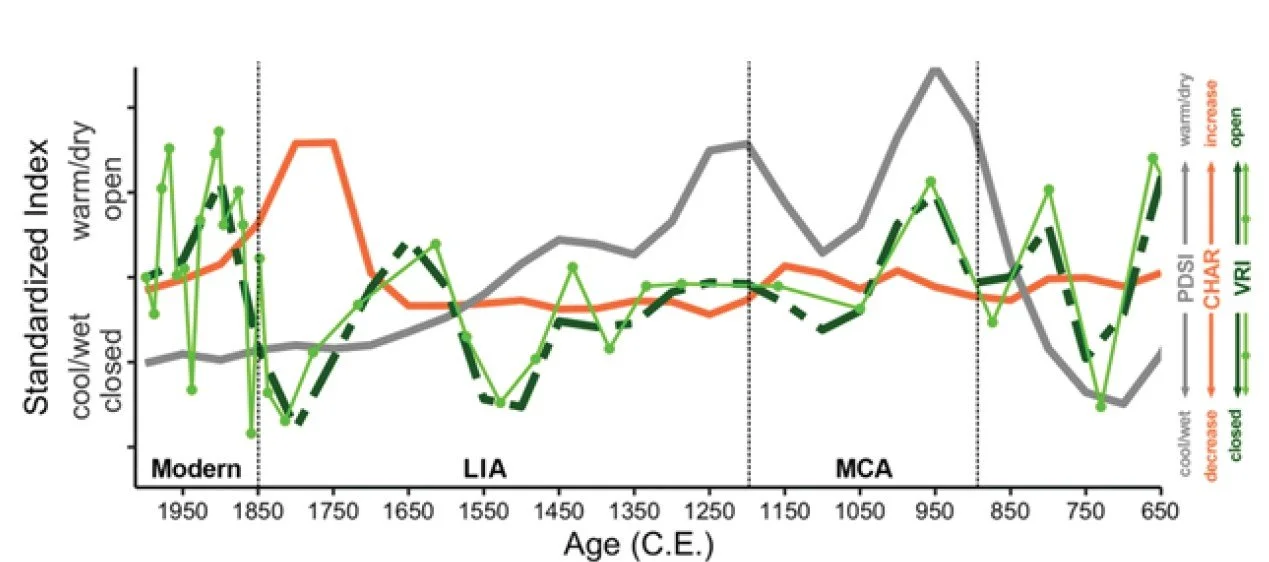
The increased frequency of large, destructive wildfires in the Sierra Nevada has been in part driven by historical management decisions that have altered the structure of forests, creating dense stands dominated by shade tolerant species with thick, flammable understory fuels. Prior to European settlement c. 1850 and the onset of fire suppression policies, abundant archaeological evidence suggests that Indigenous groups occupying the Sierra National Forest (SNF) set frequent, low-intensity fires to maintain “park-like” woodlands with clear travel corridors, productive food and game forage patches, and culturally-important plant materials such as basket-weaving grasses and oak acorns. The history of frequent fire in the SNF has been documented in the paleorecord over at least the past 1700 years as fire scars on tree rings. To this point, this fire history and coincident and subsequent shifts in forest structure have been largely attributed to climate and lightning trends rather than anthropogenic causes, even though Native Americans occupied the area since at least 6000 B.C.E. This discrepancy may be partly due to the low-intensity, slow-moving nature of Indigenous burning, potentially reducing the likelihood of scarring trees and producing sedimentary charcoal. Partitioning the effects of human vs. climatically-induced fire on Sierra Nevada forests over time is essential for understanding baseline forest structures pre-fire suppression and guiding modern restoration.

View Research Brief

View Article (Open Access)

Read More

Drivers of fire severity in three short-interval successive fires in the Sierra Nevada, California

Drivers of fire severity in three short-interval successive fires in the Sierra Nevada, California

In the mixed conifer forests of the Sierra Nevada, long-term fire exclusion has increased fuel loads and stem densities while fundamentally altering species compositions and other stand metrics relative to historical estimates. These stand conditions, along with hotter, drier, and longer fire seasons, have created increasingly large and severe wildfires across the western United States, with many areas experiencing successive reburns. Given the growing number of challenges faced by managers to increase forest resilience to future wildfires, it is crucial to understand the implications of reintroducing repeated fire into fire-excluded landscapes, and to assess the capacity of successive low-to-moderate severity fires to restore forests to resilient structural parameters.

Researchers at UC Berkeley and the US Forest Service sought to evaluate the influence of forest structure and composition, topography, and weather on fire severity in a third successive fire. They investigated the structural conditions emerging after successive burns, whether these conditions contributed to fire severity, and how these conditions compared to historical estimates. Their study utilized a network of Forest Service field plots in the Plumas and Lassen National Forests that had been initially burned in the Storrie and Rich Fires in 2000 and 2008, reburned in the Chips Fire in 2012, and were then subject to a second reburn in the 2021 Dixie Fire. Plots were sampled in 2017 and 2018 following the Chips Fire and in 2023 following the Dixie Fire.

View Research Brief

View Article (Open Access)

Read More

Drought and insect outbreaks alter fuel and potential fire behavior in two California forest types

Drought and insect outbreaks alter fuel and potential fire behavior in two California forest types

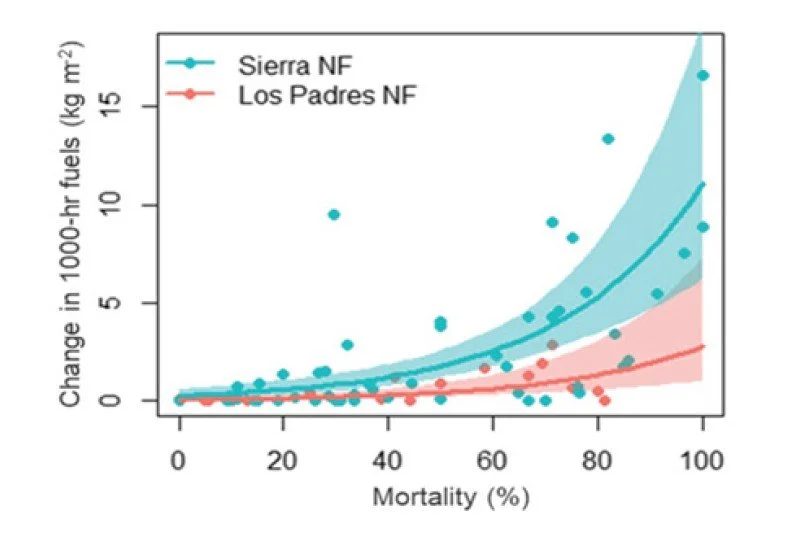
Interacting disturbances have increasingly come to shape stand structure and fuel characteristics in seasonally dry western forests. Between 2012 and 2016, concurrent multi-year drought and outbreaks of western pine beetle, fir engraver beetle, and pinyon ips resulted in the mortality of an estimated 147 million trees across California’s forests, with central and southern California being most impacted. Peak tree mortality occurred between 2015 and 2016, leading researchers to investigate changes in stand structure, fuel loading, and fire behavior in the four following years (2015-2019). Data collection occurred in forested plot networks in the Los Padres (LPF) and Sierra National Forests (SNF). Southern plots (all on the LPF) were pinyon pine and canyon live oak-dominated, while northern plots (SNF) were mixed-conifer, including ponderosa, lodgepole, and sugar pine, incense cedar, black oak, and white and red fir at higher elevation sites. Both forest types have experienced densification as a result of fire suppression over the past two centuries, leading to standing fuel continuity that, when combined with heavy, dry surface fuel loads and appropriate weather conditions, could produce severe fire behavior.

View Research Brief

View Article (Open Access)

Read More

Dead tree removal after mass mortality: Effects on regeneration, fire severity, and carbon stocks

Dead tree removal after mass mortality: Effects on regeneration, fire severity, and carbon stocks

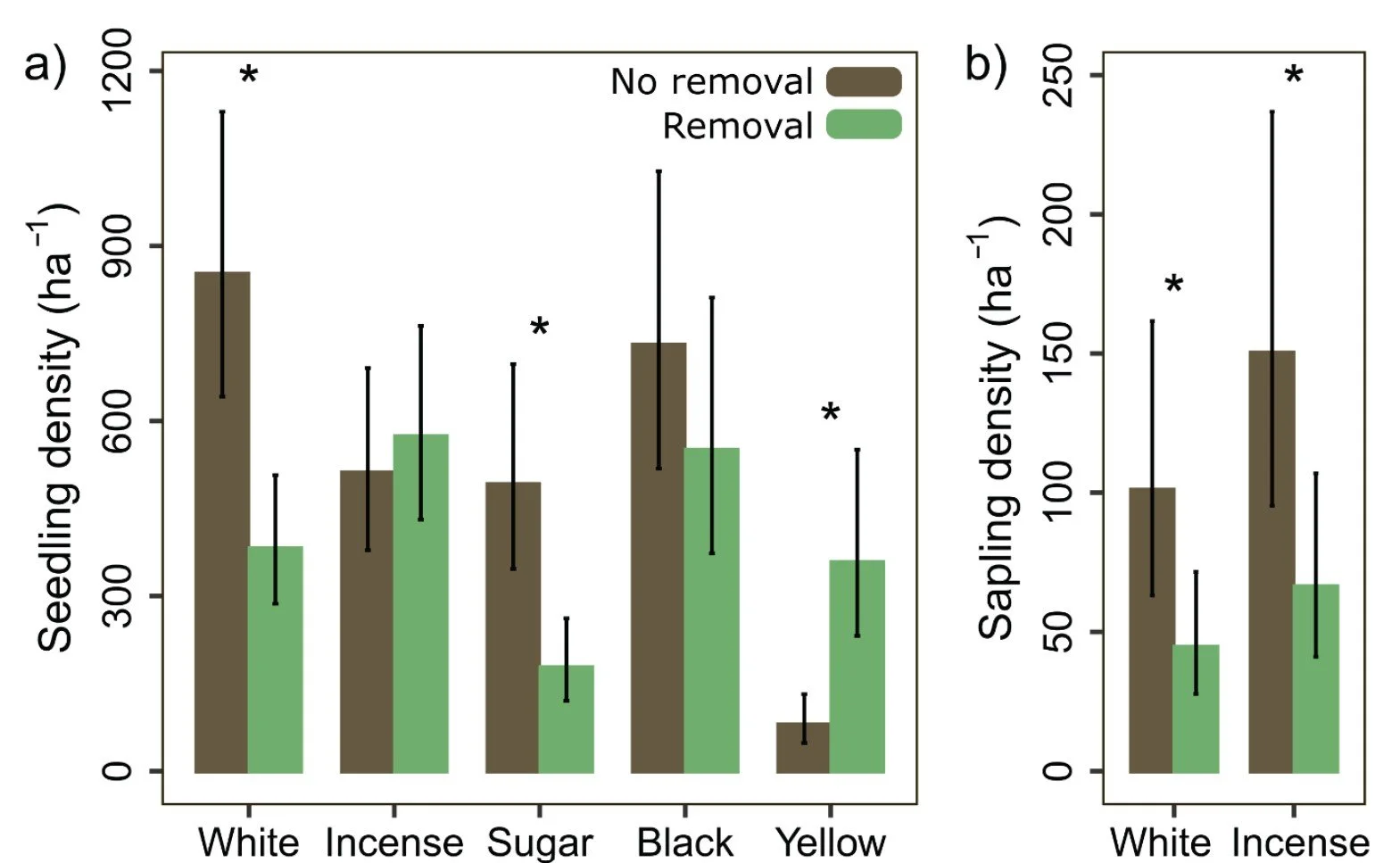
Despite the vast area and large numbers of trees affected by drought- and bark beetle-induced tree mortality worldwide, relatively little is known about how post-mortality management practices affect forest recovery, particularly in forests historically adapted to frequent fire. Cutting and removing dead trees after a mass-mortality event provides an opportunity to salvage timber and lessen wildfire risk by reducing fuel loads, but the ecological impacts of this strategy extend beyond fuel reduction. A tree mortality event of locally unprecedented extent and severity occurred in the Sierra Nevada of California, USA, during and after the exceptional 2012-2016 hot drought, providing an opportunity to evaluate the ecological effects of the management practice of dead-tree removal.

The authors compared adjacent mixed conifer forest areas with and without dead-tree removal, with the aim of assessing how dead-tree removal affects: 1) the amount and composition of forest fuels; 2) tree regeneration in the form of seedling and sapling density and species composition; 3) carbon pools; and 4) fire behavior and severity and fuel loads over the following century.

View Research Brief

View Article

Read More

Proactive fuels management for old growth conservation in the Lake Tahoe Basin

Proactive fuels management for old growth conservation in the Lake Tahoe Basin

Researchers at the University of California Davis and University of Nevada Reno modeled the outcomes of four fuels management scenarios followed by a simulated wildfire at Emerald Point in the Lake Tahoe Basin (LTB), an iconic MOG stand experiencing these vulnerabilities. The study found that a treatment involving thinning to within the forest’s historical “Natural Range of Variation” (NRV) followed by a fall broadcast burn was most effective in reducing projected large-tree mortality, maintaining stand basal area, and retaining post-wildfire live tree carbon. Researchers also discuss potential management co-benefits of treatments, such as reduced competition-driven tree mortality, increased understory biodiversity, raptor habitat conservation, and reduced air quality impacts.

View Research Brief

View Article (Open Access)

Read More

Reduced fire severity in fuel-treated forests at the Wildland-Urban Interface during the Caldor Fire (2021)

Reduced fire severity in fuel-treated forests at the Wildland-Urban Interface during the Caldor Fire (2021)

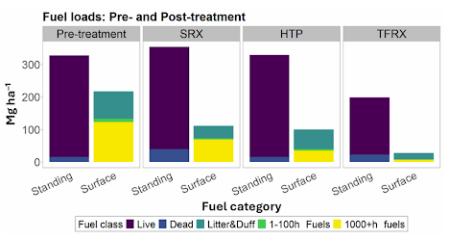
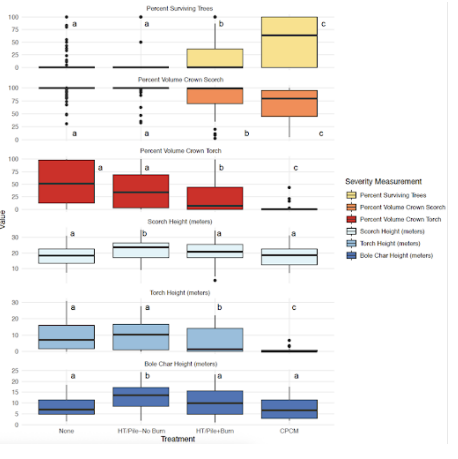
This study assessed tree and stand characteristics and metrics of fire severity in areas within the footprint of the Caldor Fire that had experienced fuel reduction by the Forest Service between the early 2000s and 2019. Treatments were varied, and included hand-thinning and piling (HTP) followed by pile-burning, HTP where the piles were still onsite, and areas where treatment involved two rounds of “cut to length” tree-felling (DBH < 76.2 cm) followed by mastication and surface fuel redistribution to stay below a threshold of 15 cm depth (CPCM). Pre- and post-treatment fuel loadings, stand densities, and basal areas were calculated by combining field data, allometric modeling methods (Forest Vegetation Simulator), and photo series. Each of these metrics was significantly lower in treated stands.

View Research Brief

Read More

Thinning + burning treatments effectively reduce fire severity

Thinning + burning treatments effectively reduce fire severity

Although fuels treatments are generally shown to be effective at reducing fire severity, there is widespread interest in monitoring that efficacy as the climate continues to warm and the incidence of extreme fire weather increases. This paper compared basal area mortality across adjacent treated and untreated sites in the 2021 Dixie Fire of California’s Sierra Nevada.

View Research Brief

View Full Article (Open Access)

Read More

Using historical aerial imagery to assess non-conifer vegetation type change under fire exclusion

Using historical aerial imagery to assess non-conifer vegetation type change under fire exclusion

Although vegetation types other than conifer forests make up the majority of burned area in California wildfires, relatively few studies quantify the drivers and patterns of vegetation change in these ecosystems. The impacts of fire exclusion on non-conifer systems remain poorly understood, and the relative influence of fuels compared to factors like climate change or type conversion on fire behavior is largely unknown. To address this knowledge gap, the authors investigated large-scale vegetation change as a possible driver of current trends in fire behavior within mixed-hardwood and shrub-dominated ecosystems in central and coastal Northern California.

View Research Brief

View Full Article

Read More

Assessing giant sequoia mortality and regeneration following high-severity wildfire

Assessing giant sequoia mortality and regeneration  following high-severity wildfire

Giant sequoia (Sequoiadendron giganteum) regeneration is reliant on local surface fires, where episodic pulses of heat desiccate and open their cones, releasing seed onto bare mineral soil. Historically, these fires were characterized as ‘mixed severity’, composed of a large matrix that burned at low or moderate severity interspersed with small forest gaps created by local high severity fire. While sequoia regeneration can flourish within these small, high severity gaps,recent ‘megafires’ have produced unprecedentedly large patches of high severity, where the majority of sequoias as killed. This research aims to help resource managers determine whether and where to replant giant sequoia after high severity wildfire.

View Research Brief

View Full Article

Read More

Where are the Sierra Nevada’s large trees and can they persist?

Where are the Sierra Nevada’s large trees and can they persist?

Identification and conservation of mature and old-growth forests has become a federal government priority.  In California’s Sierra Nevada’s most of the remaining large trees are concentrated on Forest Service and National Park Service lands. We used airborne lidar data to census large (≥30” diameter at breast height (DBH)) and very large (≥40”) trees across three large Sierra landscapes. We found that large trees are either locally absent to rare or are aggregated in stands with 8-20 large trees per acre.

View Research Brief

View Full Article

Read More

The century-long shadow of fire exclusion: Historical data reveal early and lasting effects of fire regime change on contemporary forest composition

The century-long shadow of fire exclusion: Historical data reveal early and lasting effects of fire regime change on contemporary forest composition

This study explores the effects of historical logging on tree regeneration and successive effects on stand development under a history of fire exclusion. The authors leveraged a silvicultural experiment from the 1920s in the Sierra Nevada mixed-conifer forest of the Stanislaus-Tuolumne Experimental Forest to test if silvicultural objectives of increasing pine stocking rates were met. Combining historical (pre- and post-logging in 1928-1929) and contemporary tree regeneration data along with overstory and microsite conditions, they assessed the impact of logging on pine decline.

View Research Brief

View Full Article

Read More

Heading fires consume more fuels than backing fires

Heading fires consume more fuels than backing fires

Researchers from Michigan State University and the USFS Fire Behavior Assessment Team used 15 years of immediate pre- and post-fire fuel and wildfire behavior data to identify the role of fire advancement mode and pre-fire environmental drivers (e.g., topography, fire weather, and fuel loadings) on fuel consumption and fire effects in California mixed-conifer forests.

Read More

Post-fire Mastication Effects on Shrub Regrowth

Post-fire Mastication Effects on Shrub Regrowth

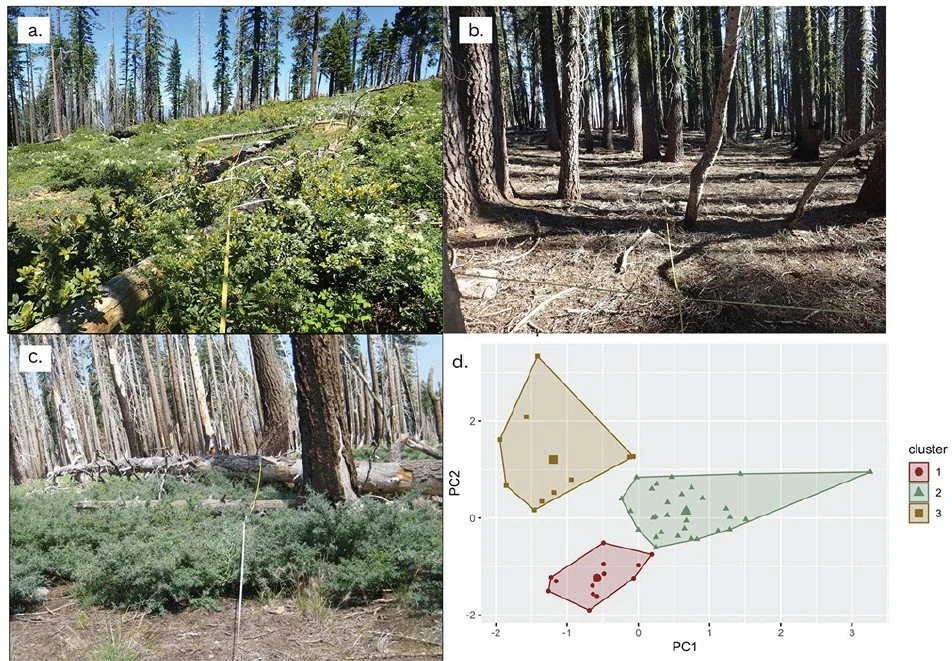
In California’s dry mixed conifer forests, increasingly large high severity wildfires threaten to convert significant areas of forested land into shrub dominated landscapes in the absence of active reforestation, including control of competing vegetation. Previous studies have found that salvage logging and other methods used to prepare a site for reforestation may reduce shrub cover after wildfire. This study investigated the effect of masticated fuel depth on shrub growth where salvage logging and mastication followed high severity wildfire.

View Research Brief PDF >

View Full Article (open access) >

Read More

Tree recruitment over centuries: influences of climate and wildfire

Tree recruitment over centuries: influences of climate and wildfire

This study uses tree cores gathered at three 4-hectare plots to make inferences about temporal aspects of tree recruitment in pine-dominated ecosystems of the California Sierra Nevada and the Sierra San Petro Martir in northwestern Mexico.

View Research Brief PDF >

Read More

Mega-disturbances & declining mature forest habitat

Mega-disturbances &amp; declining mature forest habitat

In this paper, the authors quantify change in the extent of mature conifer forests in the southern Sierra Nevada of California during 2011-2020, a decade and ecoregion characterized by compounding severe wildfires and drought follow prolonged fire exclusion.

View Research Brief PDF >

View Full Article (open access) >

Read More

Mountain quail: the lucky beneficiaries of high-severity fire

Mountain quail: the lucky beneficiaries of high-severity fire

This study uses bio-acoustical monitoring to characterize the habitat of mountain quail in the California Sierra Nevada. Findings include that high severity wildfires may promote vegetation structures that are beneficial for mountain quail.

View Research Brief PDF >

View Full Article (open access) >

Read More

Shaded fuel breaks create wildfire-resilient forest stands in the Sierra Nevada

Shaded fuel breaks create wildfire-resilient forest stands in the Sierra Nevada

This study leveraged data collected from 20-year-old forest monitoring plots within fuel treatment units that captured a range of wildfire occurrence (i.e., not burned, burned once, or burned twice) following application of initial thinning treatments and prescribed fire.

View Research Brief PDF >

View Full Article (open access) >

Read More