Simulation and Cost-Guided Fuel Treatment Planning for Prescribed-Fire Containment
/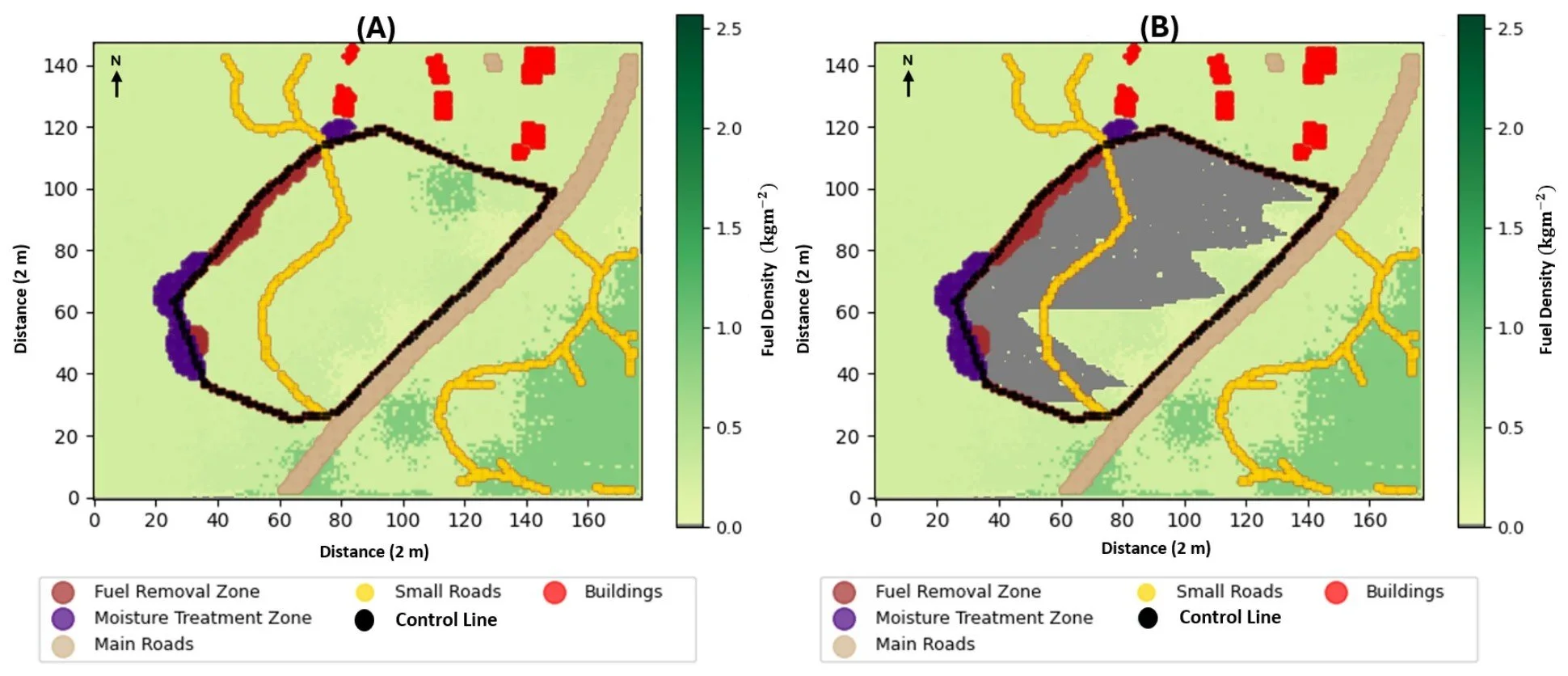
Prescribed fire is an important tool for reducing hazardous fuels, but planning a burn near roads, buildings, or other values at risk can be difficult. Managers need to decide where to strengthen containment, how much work is needed before ignition, and how to allocate limited crews and engines. These decisions are especially challenging when terrain, fuels, and wind can create localized escape pressure along the burn boundary.
This study presents a simulation-guided planning framework that combines fire-behavior modeling with treatment cost and resource constraints. The goal is not to replace expert judgment. Instead, the framework provides a structured way to test a proposed burn scenario, identify boundary locations where fire may escape, and compare alternative treatment layouts before implementation.
Matey, Yeshvant, Raymond de Callafon, and Ilkay Altintas. 2026. “Simulation and Cost-Guided Fuel Treatment Planning for Prescribed-Fire Containment.” Fire 9 (5): 187. https://doi.org/10.3390/fire9050187
Read More