Flammable Ecosystems Shaped Three Plant Syndromes

Flammable Ecosystems Shaped Three Plant Syndromes

Because the evidence for fire as an evolutionary force is so overwhelming, Pausas et al. (2016) conveniently organized fire-adapted plant species into three syndromes for better management. The resulting Non-Fast-Hot syndrome scheme shows how different plant species likely evolved to either resist or use three dimensions of flammability (ignitability, fire spread rate, and heat release) for higher fitness. 

View Research Brief PDF >

Read More

Two Historical Data Sets Tell Different Fire Stories: Research Brief

Two Historical Data Sets Tell Different Fire Stories: Research Brief

A comparison of two historical fire history data sets, the State of California Fire and Resource Protection (FRAP) database and a database based on annual state and federal written reports, found substantial differences between the two.

View Research Brief PDF >

Read More

Pyrodiversity Doesn’t Always Increase Biodiversity: An Example from Australia: Research Brief

Pyrodiversity Doesn’t Always Increase Biodiversity: An Example from Australia: Research Brief

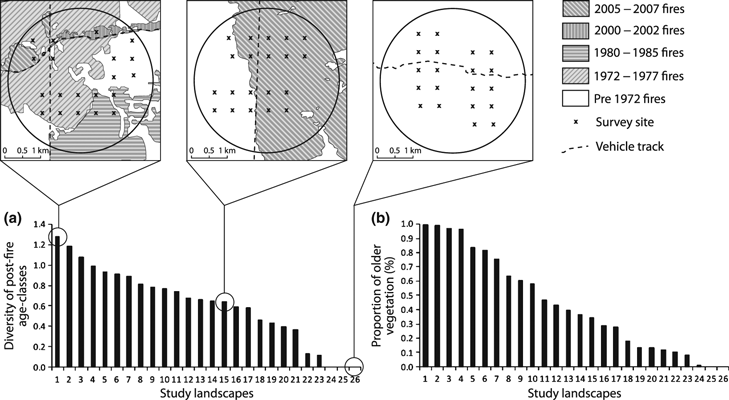
Site-scale sampling methodologies could be misleading, especially for arid, geographically heterogeneous, biodiversity hotspots. These authors (Taylor et al. 2012) use a landscape-scale methodology to examine one such habitat, 'tree mallee' that has similar fire and ecologic traits to central and southern semi-arid habitats like chaparral. In addition, this study shows that postfire age class heterogeneity doesn’t increase avian species richness in this semi-arid habitat with long fire return intervals.

View Research Brief PDF >

Read More

Drought and Fire in California: Research Synthesis

Drought and Fire in California: Research Synthesis

The likely effects of drought associated with climate change in the United States have recently been synthesized by James M. Vose, James S. Clark, Charles H. Luce and Toral Patel-Weynand. Here we summarize their conclusions as they apply to drought and fire and provide examples of how these conditions are affecting different ecosystems in California.

View Research Brief PDF >

Read More

Old-forest Species Threatened by Megafires: Research Brief

Old-forest Species Threatened by Megafires: Research Brief

The King Fire burned through an area used for a long-term (23 years) demography study of spotted owls in the central Sierra Nevada, allowing the authors to compare the number and distribution of owls both before and one year after the fire. 

View Research Brief PDF >

Read More

Strategic Land Purchases for Private Land Conservation to Reduce Fire Risk: Research Briefs

Strategic Land Purchases for Private Land Conservation to Reduce Fire Risk: Research Briefs

In Southern California,  fuel treatment strategies often put fire risk reduction and biodiversity conservation goals at odds with each other. In response to this conflict, two of our briefs (Syphard et al. 2016; Butsic et al. 2016) explore a novel new approach. 

Read More

Increased fire area and severity in the Sierra Nevada warrant fuels reductions and wildland fire use

Increased fire area and severity in the Sierra Nevada warrant fuels reductions and wildland fire use

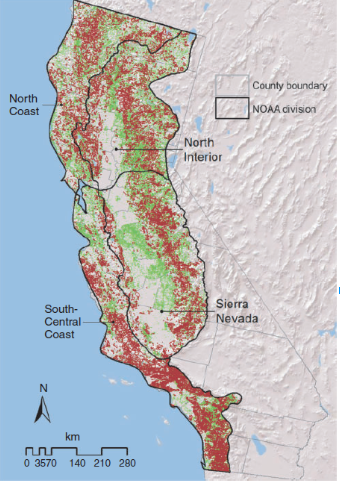
The authors assessed relative and absolute changes in wildfire area and severity in seven forest types arrayed along an elevational gradient in the Sierra Nevada and adjacent forested mountains. Findings suggest that there is a major fire “deficit” in the greater Sierra Nevada Region, across all major forest types. However, the nature of this deficit differs among forest types.

View Research Brief PDF >

Read More

Shrub control associated with reforestation in high-severity burn areas promotes understory diversity: Research Brief

Shrub control associated with reforestation in high-severity burn areas promotes understory diversity: Research Brief

Bohlman et al. conducted a study looking at the effects of post-fire reforestation on understory plant species richness and composition, as well as stand structure. Three different aged fires were selected to assess the role of time since fire on the different stand components.

View Research Brief PDF >

Read More

Influence of post-fire vegetation and fuels on fire severity patterns in reburns: Research Brief

Influence of post-fire vegetation and fuels on fire severity patterns in reburns: Research Brief

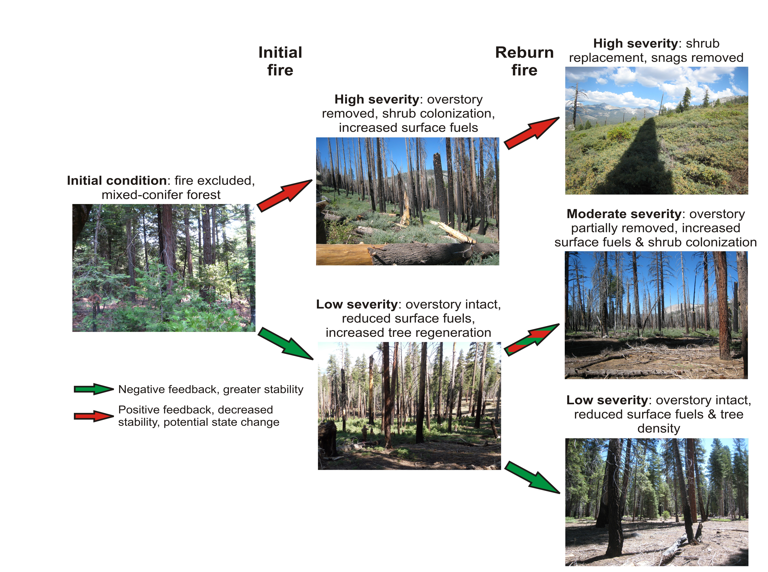
Results from a 2016 study by Coppoletta and others suggests that in areas where fire regimes and forest structure have been dramatically altered, contemporary fires have the potential to set forests on a positive feedback trajectory with successive reburns, one in which extensive stand-replacing fire could promote more stand-replacing fire.

View Research Brief PDF >

Read More

Predicting Future Fire Regimes: Still a Long Way to Go: Research Brief

Predicting Future Fire Regimes: Still a Long Way to Go: Research Brief

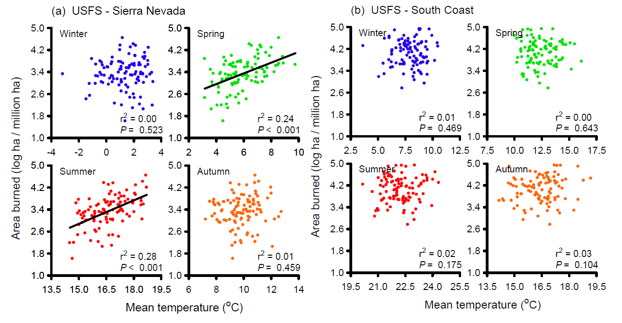
In a review article by Jon Keeley and Alex Syphard, examples from California show that fire regimes are sensitive to geographic and seasonal variation in the climate signal and that many factors will confound the ability to model future conditions.

View Research Brief PDF >

Read More

Wildfires Differences among Agencies and Ecoregions in the Sierra Nevada: Research Brief

Wildfires Differences among Agencies and Ecoregions in the Sierra Nevada: Research Brief

A 2012 study by Miller and others suggests that fire management approaches used by the National Park Service in Yosemite National Park could assist in the restoration and maintenance of Sierra Nevada forest ecosystems.

View Research Brief PDF >

Read More

High Elevation Extremes Limit Alien Plant Success: Research Brief

High Elevation Extremes Limit Alien Plant Success: Research Brief

Why aren’t globally successful, weedy plant species generally found at high altitudes? This study suggests that it’s due to extreme abiotic conditions in association with the alien species’ life history traits, not a lack of opportunity. 

View Research Brief PDF >

Read More

Pratt’s Arguments Against “Light Burning” in 1911: Research Brief

Mr. Pratt in 1911 published an argument against the “light burning” practices of those days, claiming these small fires were unnecessary and only caused an expensive loss of merchantable lumber over the years. Like other light-burning advocates, he had no research on his side.  
 View Research Brief PDF >

Read More

Synthesizing Best-Management Practices for Desert Tortoise Habitats: Research Brief

Synthesizing Best-Management Practices for Desert Tortoise Habitats: Research Brief

In a collaborative project funded by the non-profit Desert Tortoise Council with Natural Resource Conservation LLC, the authors synthesized published literature and practitioner’s experiences to develop best-management practices for habitats of desert tortoises. 

View Research Brief >

Read More

Restoring Desert Biocrusts after Severe Disturbances: Research Brief

Restoring Desert Biocrusts after Severe Disturbances: Research Brief

Collaboratively with the National Park Service, the authors performed a study along Northshore Road in Lake Mead National Recreation Area (eastern Mojave Desert, Nevada) to develop biocrust restoration strategies. Results and management recommendations for the most effective restoration methods are discussed. 

View Research Brief PDF >

Read More

"Light Burning" Debate in the early 1900's: Research Brief Series

In the early 20th century, there was an intense controversy over systematic “light burning, the practice of using cool fire as a management tool (similar to what we call prescribed fires today). These practices for fire control were highly debated before fire suppression policies overwhelmingly prevailed. Presented here is a series of research briefs that review publications from this controversy at this interesting look into history.

Read More