The 1967 Handbook for Type-converting Chaparral: Research Brief
/This 1967 handbook recommends a standardized type-conversion process for Chaparral in five steps.
View Research Brief PDF >
Read More
This 1967 handbook recommends a standardized type-conversion process for Chaparral in five steps.
View Research Brief PDF >
Read More
The Fuel Break Program was a historic, systematic effort to type convert mosaics linked by firelines with the goal of containing and/or controlling southern California chaparral wildfire.
View Research Brief PDF >
These historic Angeles National Forest fires were almost all caused by people. At first, these ignitions were tolerated, but as people witnessed more flooding & erosion, they clamored for government intervention.
Read MoreAuthors of this paper present quantitative information on the differences in stand structure, fuel loading, and fire behavior in current and reconstructed riparian and upland areas in the Sierra Nevada.
View Research Brief PDF >
With four different goat-grazing treatments at different stocking rates, the authors explored the effects of goat-grazing on type-converted shrub systems in Arizona.
View Research Brief PDF >
A USGS study reports that after the 2003 fires, burned coastal sage scrub (CSS) plots displayed a significant shift in the overall community structure of ground foraging ant species.
View USGS Research Brief PDF >
In southern California, the slopes are famous for producing high sediment yields following fires. The authors showed that large volumes of sediment are released when the “dams” are burned in wildfires in these ecosystems.
View Research Brief PDF >
This paper summarized the results of 200 social science studies primarily from western North America to identify key lessons. They present 25 key research needs.
View Research Brief PDF >
Using a simple caging experiment, the researchers investigated impacts of herbivory on seedling establishment of two chaparral species after a prescribed fire.
View Research Brief PDF >
The forest succession model LANDIS was modified to provide reasonable simulations of fire effects in chaparral shrublands.
View USGS Research Brief PDF >
This paper shows that unburned chaparral stands greater than 50 years old are healthy, relatively stable plant communities, not the stagnant, unnatural stands once historically thought.
View Research Brief PDF >
Five fire simulation models used from all over the world were compared: EMBYR, FIRESCAPE, LANDSUM, SEM-‐LAND, and LA-‐MOS(DS).
View Research Brief PDF >
The objective of this study was to investigate the influence of thinning treatments on fuel moisture and determine whether or not moisture patterns differ by treatment in mixed conifer stands in northern California.
View Research Brief PDF >
This paper examined the 20th century fire history of the San Francisco East Bay landscape to understand to what extent fire management activities could account for changes in landscape patterns.
View USGS Research Brief PDF >
The 2003 and the 2007 wildfires in San Diego County were remarkably similar in their causes, impacts and the human responses they elicited.
View USGS Research Brief PDF >
In a 2011 paper, researchers examined the short-term consequences of mechanical thinning for forest animal abundance and diversity by summarizing the results of 33 studies from throughout the continent.
View Research Brief PDF >
This paper investigates the effects of large-scale wildfires on entire bird communities across multiple vegetation types.
View USGS Research Brief PDF >
This 1993 paper followed an earlier study that showed repeated fire a short intervals in chaparral could kill fire-dependent native shrubs, alter pre-fire community structure, and favor alien annual grasses and forbs.
View Research Brief PDF >
An article provides an overview of key factors, concepts and tools to understand the ecological resistance to biological invasion and resilience to fire of desert shrublands of North America.
View Research Brief PDF >
In a study of three prescribed fires in a mixed-‐ conifer forest at Sequoia and Kings Canyon National Parks, researchers found that the predicted probability of sugar pine survival was 60% for raked trees compared to 7% for un-‐raked trees when the total fuel depth was greater than 30cm.
View Research Brief PDF >

The California Fire Science Consortium is divided into 4 geographic regions and 1 wildland-urban interface (WUI) team. Statewide coordination of this program is based at UC Berkeley.
View the about page to learn more >
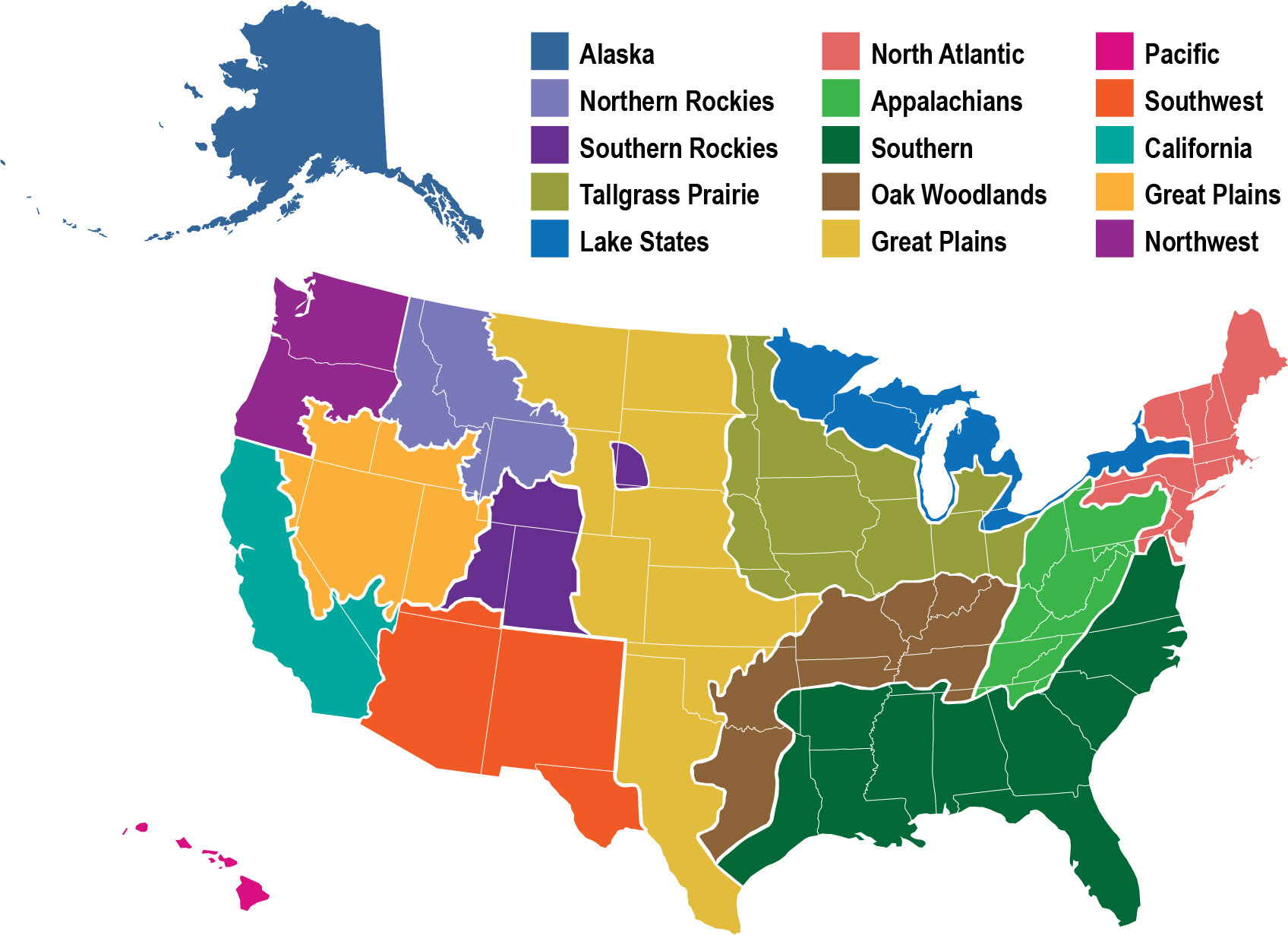
This regional Fire Science Exchange is one of 15 regional fire science exchanges.
Link to another exchange: