Abstract: Wildfires can be a powerful regenerative force for nature. However, modern wildfires in frequent fire forests across the Western U.S. have become uncharacteristically severe, largely due to climate change and more than a century of fire suppression. Mechanical thinning and prescribed fire are used to reduce wildfire size and severity, but compliance restrictions and logistical challenges, as well as agency staffing capacity and funding constraints, often limit the scale of their treatment. However, even wildfires with large areas of high severity, which is destructive to both forests and people, also include substantial areas that experienced low to moderate severity fire effects, which can be considered beneficial wildfire. We will cover the results from two recent papers that use the historically frequent-fire forests of the Sierra Nevada California as a case study, to document the extent of beneficial wildfire and current forest conditions, as well as potential ways to leverage recent wildfires to increase forest resilience to future fire. In the first study, we found that from 2001-2022, beneficial wildfire treated ~17% more area than all thinning or prescribed fire treatments combined. Moreover, when considering the current state of resistance to high severity fire, which is defined by both wildfire patterns and treatment, we found that 47% has no resistance, but ~33% has some level of resistance, primarily as a result of beneficial wildfire. We then used these results in a follow-up paper to identify the extensive opportunities to build on the beneficial work of recent wildfires by using burned edges as containment lines and implementing follow-up treatments where beneficial wildfire was a “first entry” treatment. We identify three pathways (create, enhance, and maintain) that leverage wildfire footprints to increase resistance to high-severity fire and map the opportunities across the Sierra Nevada at the POD scale. Finally, we highlight enabling factors and Clean Air Act, NEPA, and Wilderness regulations that, if revised, would allow more prescribed fire and resource objective wildfire in wildfire footprints.
Presented by:
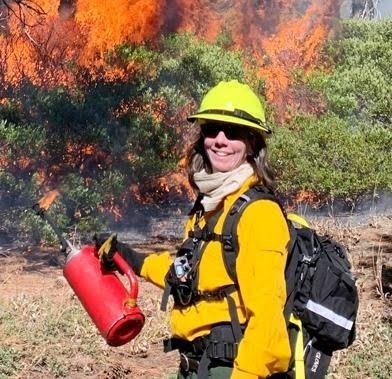
Kristen Wilson is a Lead Forest Scientist with The Nature Conservancy’s California chapter – Climate and Land Use Program. She leads the Forest Strategy science team who provide support for the strategy through conservation planning and research. The team identifies priority locations for reducing the risk of high-severity wildfire to biodiversity and quantifies the benefits of forest thinning and beneficial fire. Kristen also researches natural climate solutions to mitigate climate change and stream restoration design including the role of beaver as restoration agents. She holds a Ph.D. in environmental planning from the University of California, Berkeley.
Kristen Shive is an Assistant Cooperative Extension Specialist at UC Berkeley. Her work broadly focuses on understanding the impacts of modern wildfires, prioritizing areas for restoration and restoring fire to fire-adapted ecosystems. She has 20 years of experience in conservation, forest and fire management, ecology and science, working for the National Park Service, Save the Redwoods League and The Nature Conservancy. She holds an M.S. in Forestry from Northern Arizona University and a Ph.D. in Environmental Science, Policy and Management from UC Berkeley.